
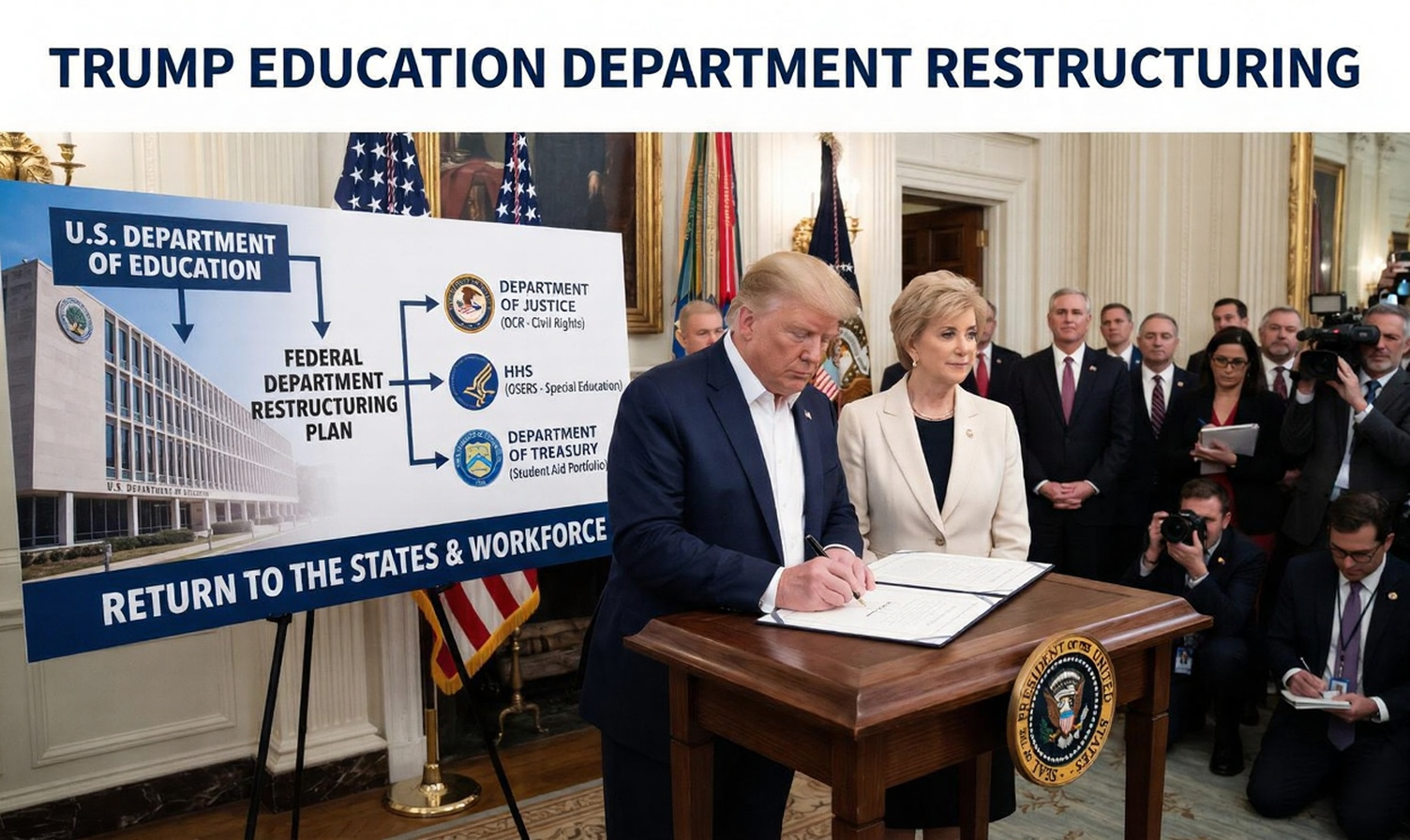
The promise to dismantle the federal Department of Education has been a conservative rallying cry for decades. However, during his second term, President Donald Trump has bypassed a stalled Congress by initiating a systematic trump education department restructuring designed to hollow out the agency from within.
Instead of waiting for a legislative shutdown—which requires a congressional approval that isn’t currently there—the administration is executing this trump education department restructuring through sweeping staff cuts and Interagency Agreements (IAAs). By outsourcing primary duties to other federal departments, the administration is effectively altering how education policy is managed in America, moving oversight “back to the states“.
The Core Strategy: Dismantling via Outsourcing (Trump Education Department Restructuring)
Because completely closing a cabinet-level department requires an act of Congress, Education Secretary Linda McMahon has utilized executive shifting to achieve the administration’s goals. Over the past year, the Department of Education has struck over a dozen internal agreements to offload its core programs onto other agencies.
The biggest and most controversial shifts occurred in mid-June 2026, targeting the final two massive pillars of the agency: special education and civil rights enforcement.
Here is exactly where the department’s primary responsibilities are being reassigned:
- Special Education (OSERS): Moved to the Department of Health and Human Services (HHS). This office oversees billions in funding and monitors state compliance with the Individuals with Disabilities Education Act (IDEA).
- Civil Rights Enforcement (OCR): Transferred to the Department of Justice (DOJ). This department handles heavy-hitting cases, including Title IX violations and complaints regarding discrimination based on race, religion, or sex.
- K-12 & Adult Career Programs: Functionally shifted over to the Department of Labor (DOL) to more closely tie school programs into workforce development.
- Federal Student Aid Portfolio: Major management operations for the massive $1.6 trillion student loan portfolio have transitioned over to the Department of Treasury.
The Timeline of the Restructuring
The reshaping of federal education oversight has moved far faster than critics originally anticipated. Here is how the dismantling has progressed since Trump took office for his second term:
The Inception
March 20, 2025
President Trump signs an executive order directing Secretary Linda McMahon to begin the formal process of closing the Department of Education and scaling back federal workforce oversight.
Workforce Halved & Legal Battling
Summer 2025
The Department of Government Efficiency (DOGE) announces massive staff layoffs. Following a brief legal block by lower federal courts, the Supreme Court rules in July 2025 that the administration can proceed with workforce reductions, cutting the staff nearly in half.
Voucher Program Enacted
July 2025
A new federal voucher program is signed into law via budget reconciliation, directing tens of billions of dollars toward giving families funding alternatives outside of traditional public school systems.
The Final Major Handoff
June 16, 2026
The administration shifts its final major offices—Special Education and Civil Rights—to HHS and the DOJ respectively, leaving the remaining skeleton department to handle only statutory obligations like final audit sign-offs.
The Fierce Debate: Two Sides of the Coin
The administration maintains that federal micromanagement has hindered local success. Secretary McMahon noted that the administration is “bolstering the efficacy of federal oversight where it is essential” while getting the federal bureaucracy out of the way of local school boards and parents. Proponents believe this will curb federal overreach and give states the flexibility to spend education dollars where they see fit.
Conversely, public school advocates and civil rights groups are deeply alarmed. Critics warn that scattering specialized educational programs across massive, non-educational agencies like the DOJ and HHS will severely erode protections for vulnerable populations. Disability rights groups explicitly argue that treating special education as a “medical issue” under HHS reverses decades of progress that prioritized integrating individuals with disabilities directly into classroom environments.
Whether these interagency handoffs will survive ongoing legal challenges from congressional Democrats and education unions remains to be seen—but for now, the Department of Education as we once knew it has completely changed shape.